Know why it won.
Then make yours.
Rivet Lab scans a creator's account, finds the videos that beat that creator's own average, and takes the winners apart, every word, every cut, every sound, until "why did this work" has a measured answer.
Every tool I found does half the job.
Some tools collect winning videos but can't say why they won. Others write scripts but can't show where their advice comes from. Rivet Lab runs the whole loop: find what wins, understand why, make yours in that shape. Every claim carries its receipt: the account, the views, the ratio, the exact second it happened.
What can't be copied is the loop, not the lookup.
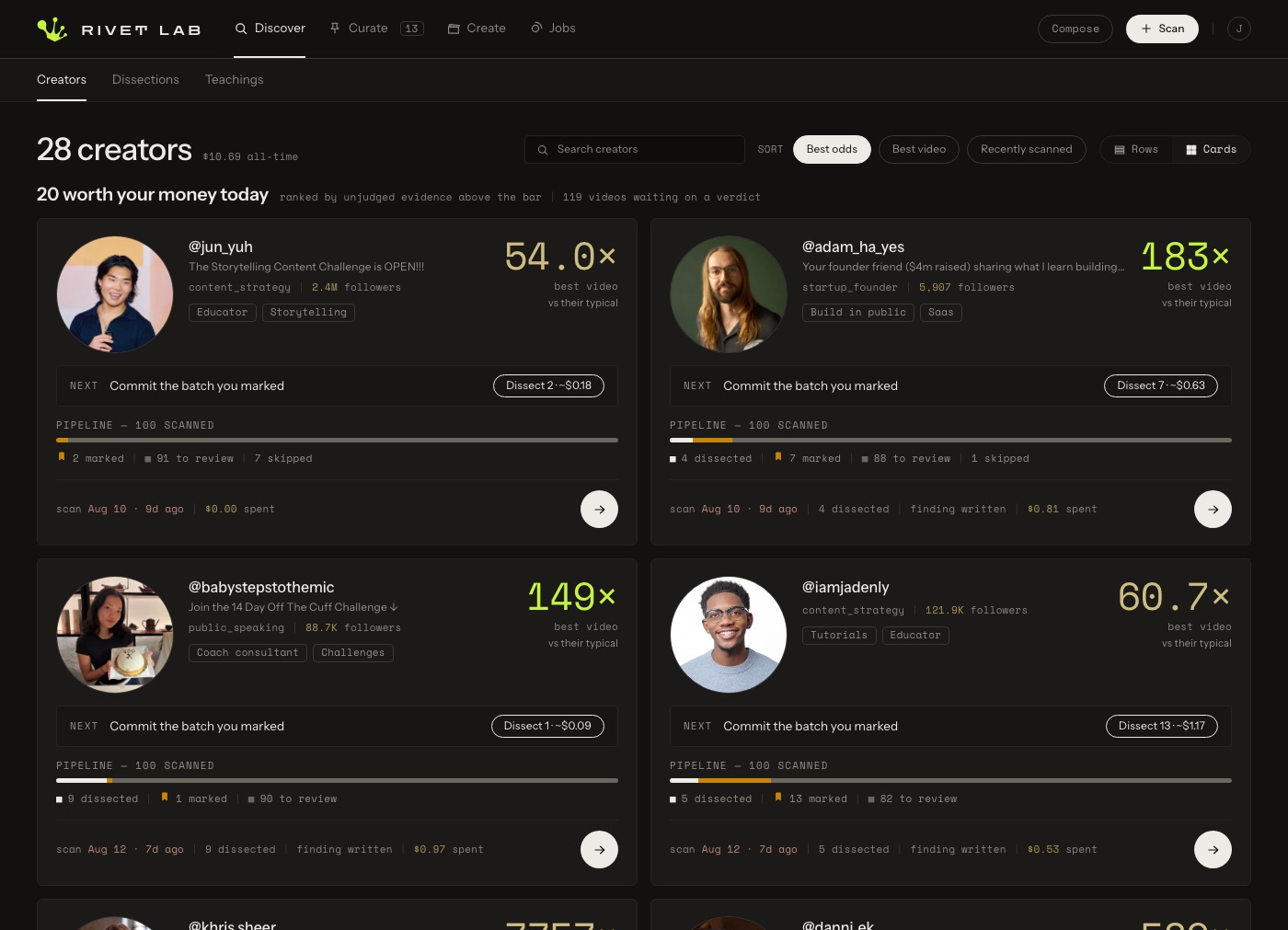
Point it at any account. It finds the winners and takes them apart.
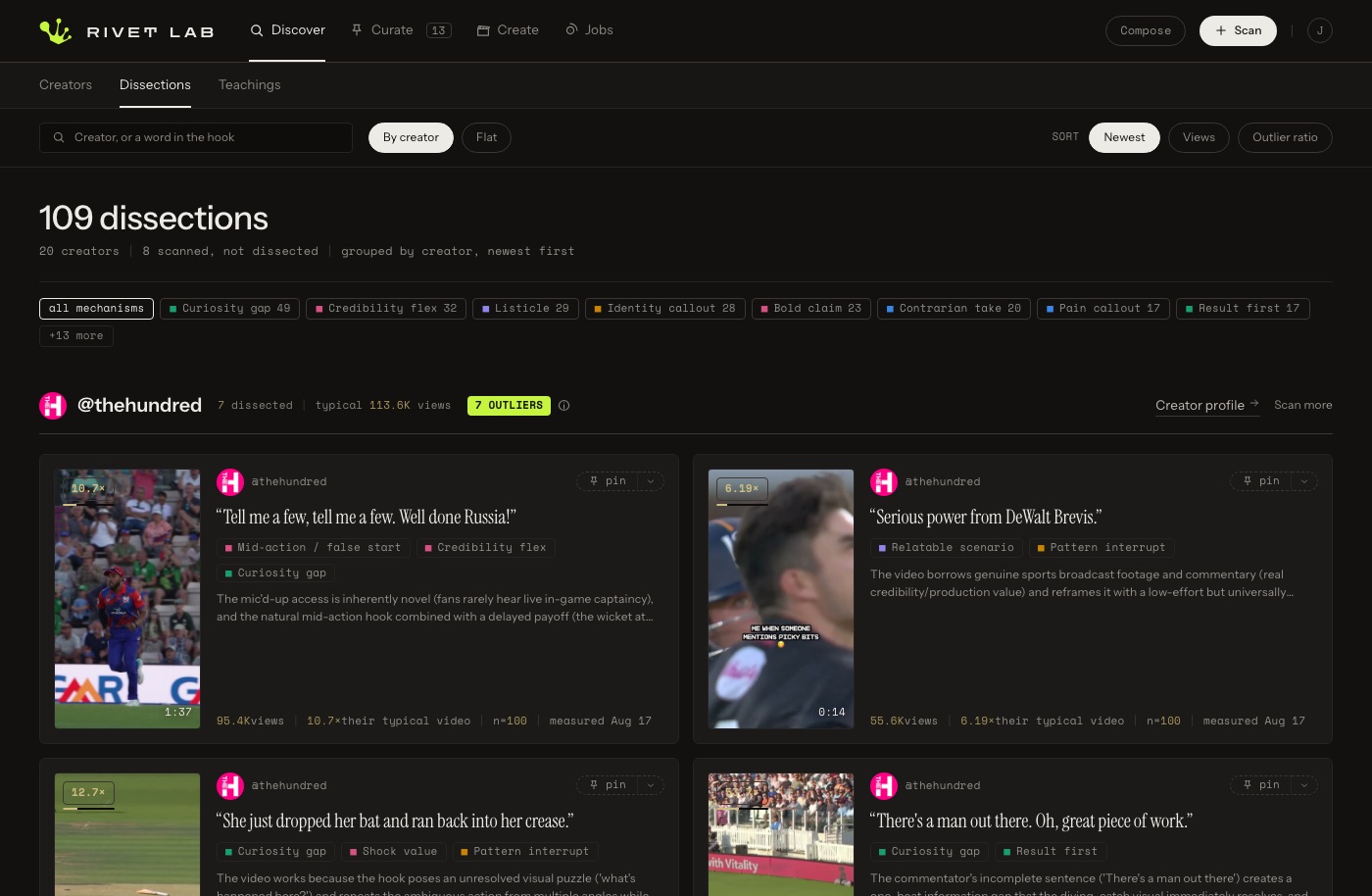
Scan, dissect, curate, create. Each one hands its work to the next, and enough dissections of a single creator turn into a manual. Real screens below, real data in every one.
Point it at any public account.
It pulls the recent catalog and computes each video's outlier ratio: views divided by that account's typical video. Typical means the median of its last 20 mature videos, the middle one, not the average, so one runaway hit can't inflate the bar. Mature means older than a week; anything younger is flagged too fresh to rank, never hidden.
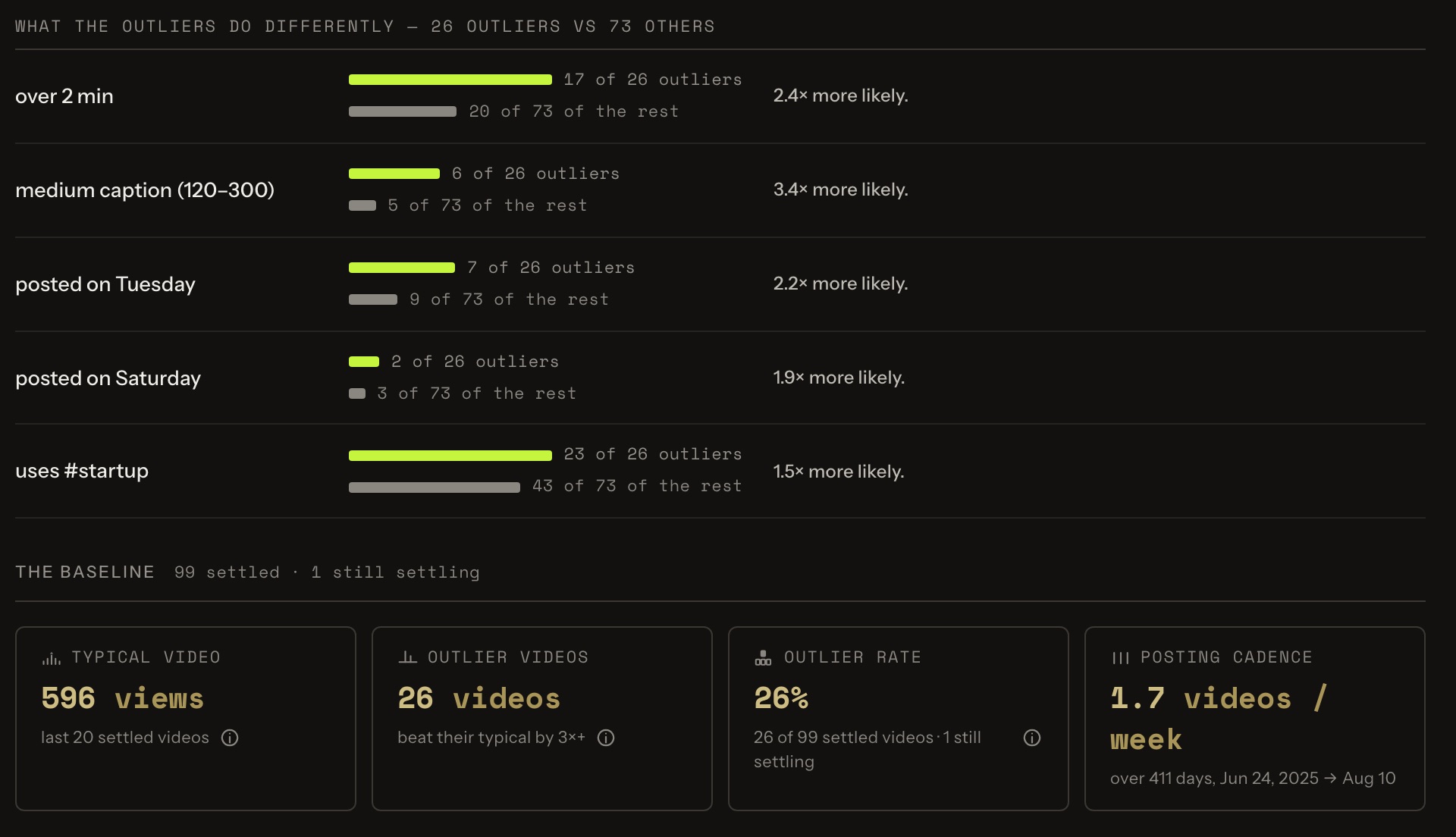
One video, taken apart.
Every spoken word with its timestamp. The hook, the first seconds that decide whether a viewer stays, isolated and read for its mechanism. The beats of its structure, pace in five-second windows, on-screen text with appearance times. Then how it was made: cut rhythm, color palette, caption styling, every sound effect isolated into a playable clip with a searchable name.
Fonts are described, never named. The AI that watches the frames can describe a typeface but not name it, and the screen says so.
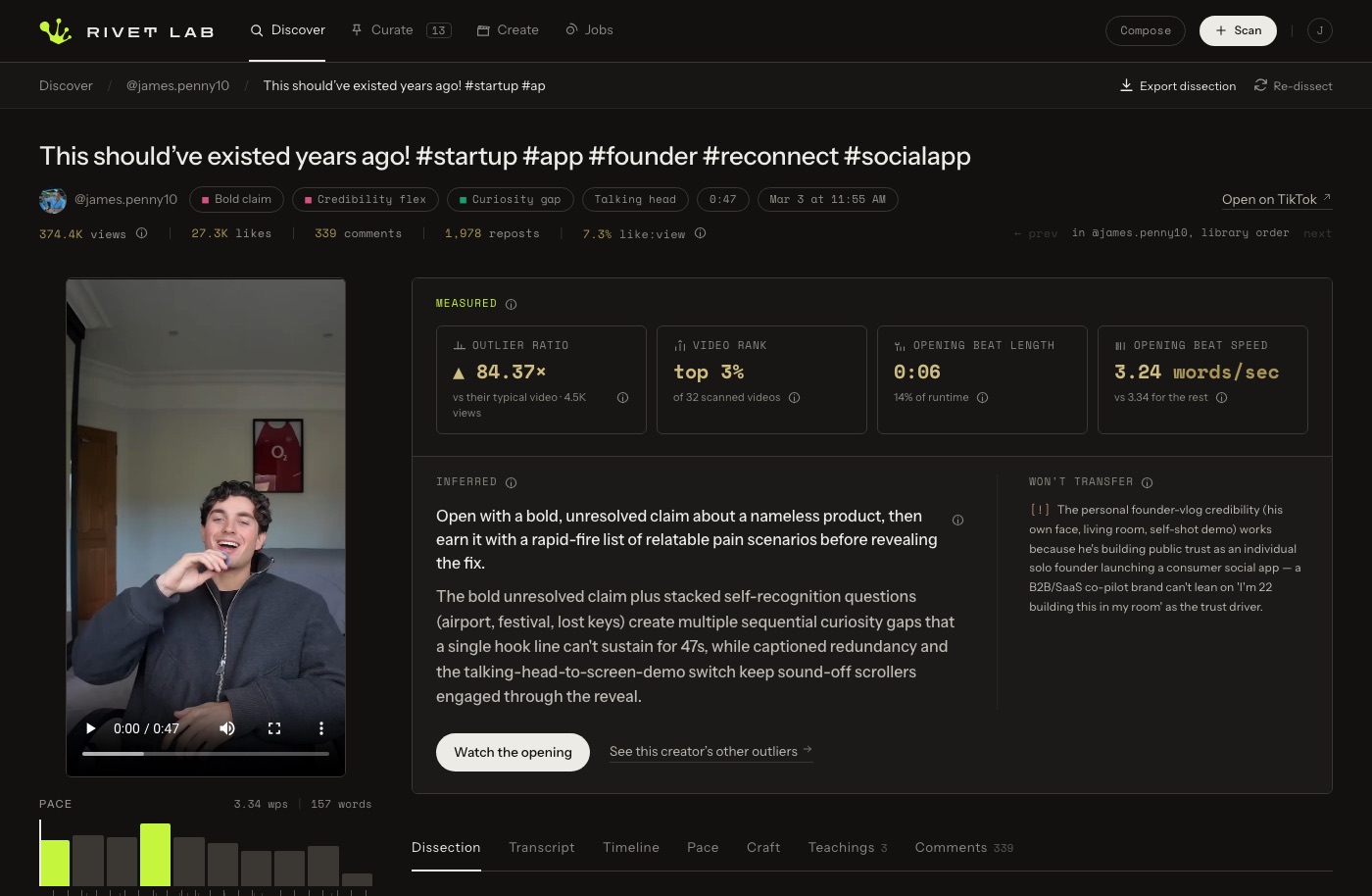
Pin what teaches you.
Hooks worth stealing, structures worth reusing, and what creators teach across a whole account: frameworks with cross-video repetition counts, comment sections read like a researcher reads interviews, themes with verbatim quotes.
Your pins become a board, and the board reads its own composition back: which kinds you lean on, which you never reach for, and what that says about the videos you are about to make.
Pins become scripts. Scripts become shot lists.
The studio drafts hook variants in the shapes it has studied, with pace targets per line. Lock the script and it generates the shot list: what to film, where the cuts land, which sounds to use. Then an edit brief, ready to hand to an editor, human or AI.
Every suggestion cites which video taught it. Nothing arrives without a source.
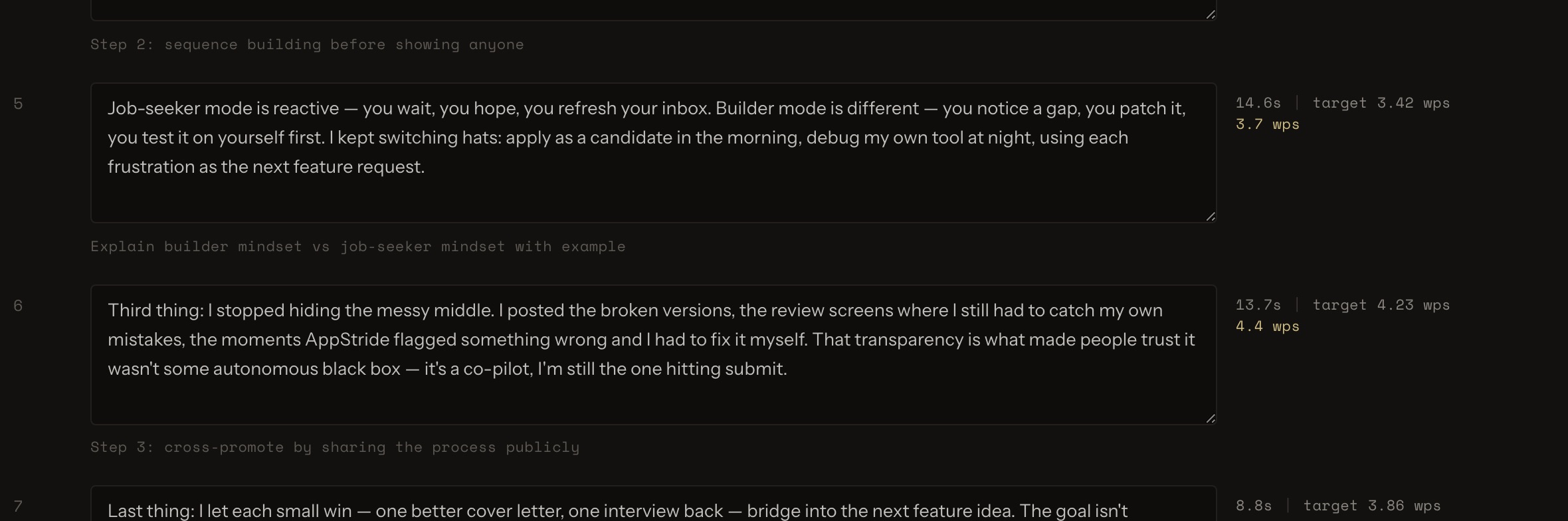
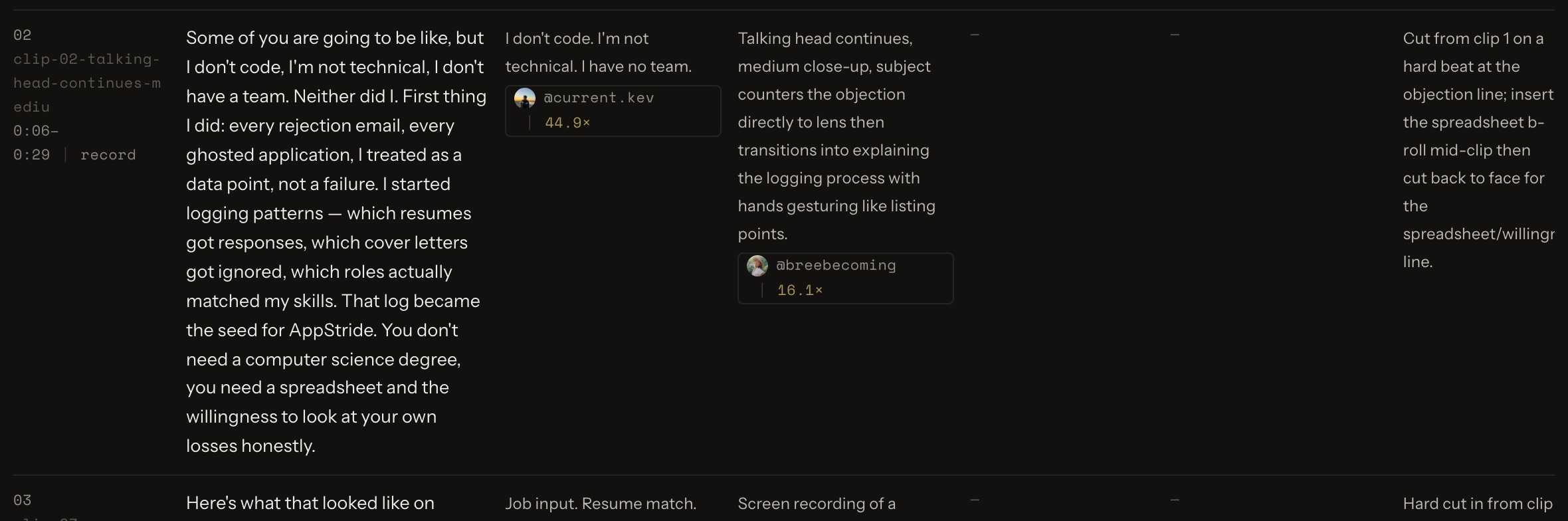
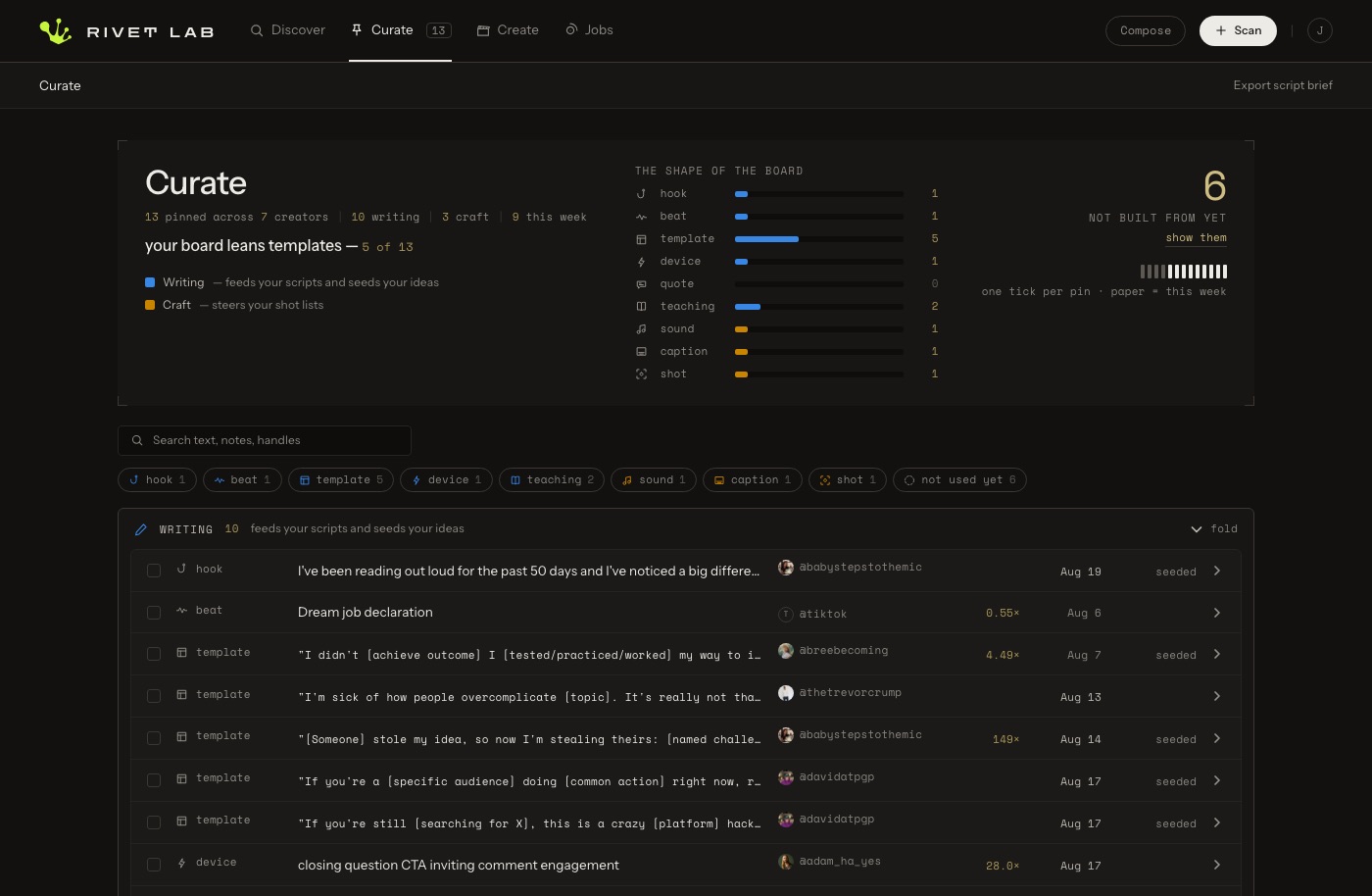
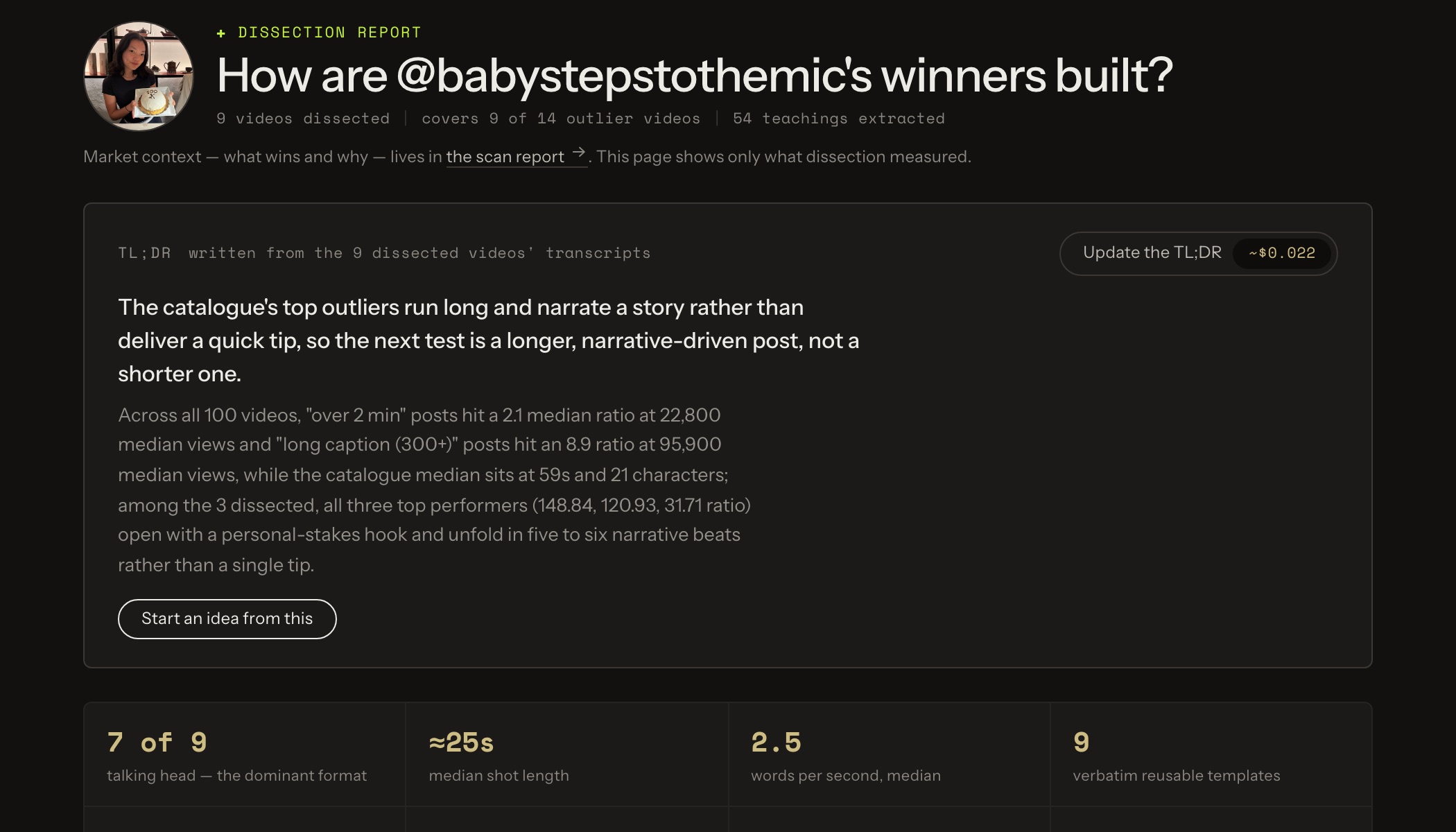
Dissect enough of one creator and it writes the manual.
How their winners open, how long the hook runs, what holds attention, how they ask for the follow. Nine templates you can rebuild word for word, each carrying the video it came from and how far that video beat their own average.
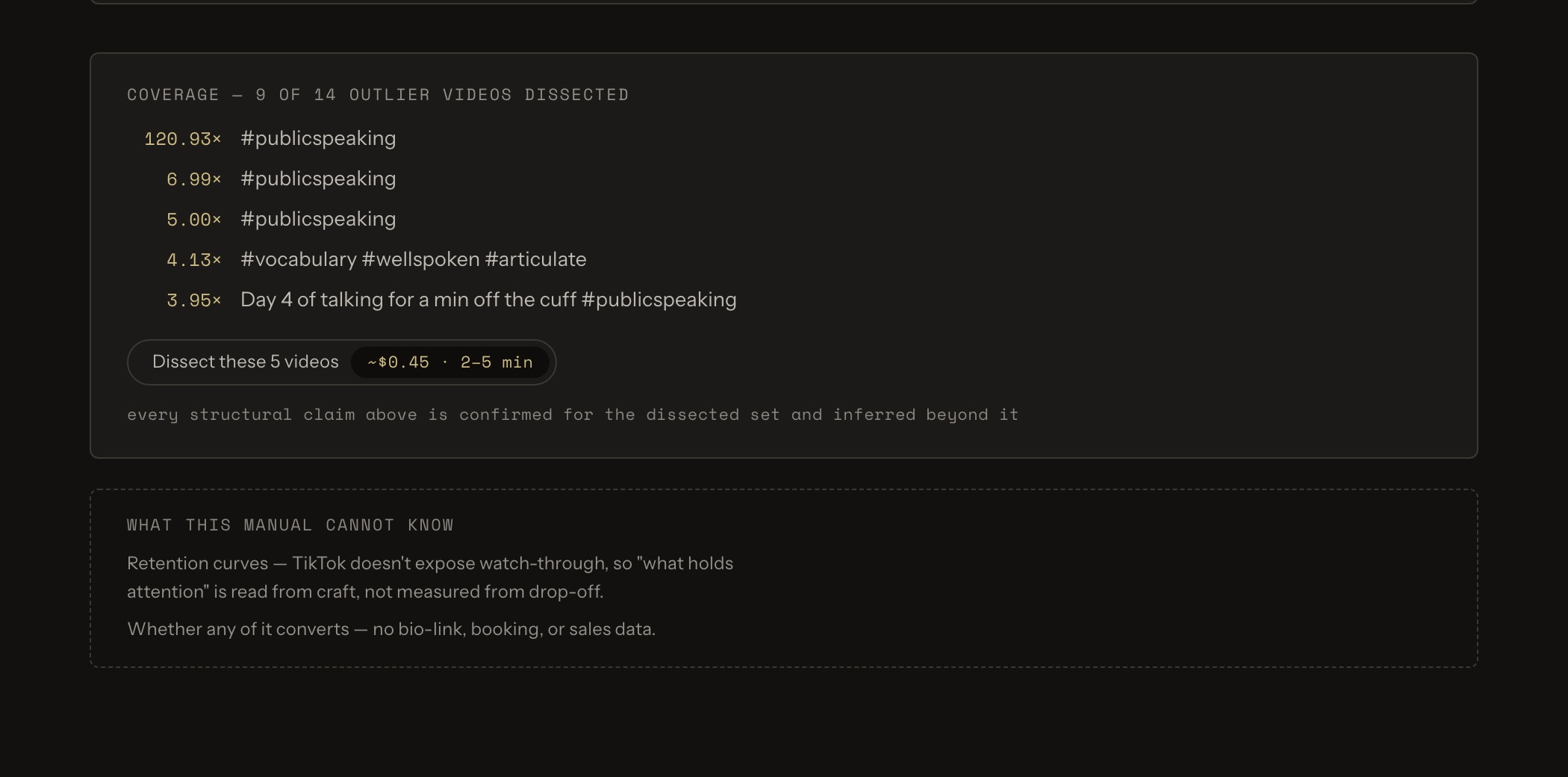
Then it states its own coverage and its own limits. Nine of fourteen outlier videos dissected, with the five it has not read yet listed underneath and the price to finish them. A panel titled what this manual cannot know says TikTok never exposes watch-through, so what holds attention is read from the craft rather than measured from where viewers left, and nothing here knows whether any of it converts.
Someone else used it, and changed her strategy in the same minute.
“That's one of the most incredible things that I've ever seen.”
said in a recorded working session, august 2026 · not a testimonial, and not solicited
Her account, scanned live at the first demo. 8 outliers out of 92 videos. Her winners run 30 to 60 seconds. Four of the eight went up on a Tuesday, while only 12 of her other 90 did. Saves and comments near absent, which the instrument read plainly: she optimizes for algorithmic reach, not community dialogue. She saw the shift herself, before I said anything.
Now the part you can't see:
One person built this.
In thirteen days.
I'm Josue Reyes. I build entire platforms, and I document every decision.
The reason I can is a process I've practiced until it's muscle: deep customer research, the jobs people are hiring the product to do (jobs to be done), user goals and flows, information architecture, product requirement docs (PRDs), prototypes. Then design loops between Claude Code and Claude Design until the interface is right. I call the working method parallel pair programming: I'm the orchestrator, part pair-programmer, part product manager, making hundreds of decisions a day. Hundreds. Count the commits.
AppStride came first, a job-application platform with a production browser extension. Started in March, running in six weeks, polished ever since while I learned to make this process fast. Rivet Lab is the second run.
fast is common now. fast that holds up is the skill.
It started as a marketing errand.
AppStride needed a TikTok channel, and I refused to guess at what makes videos work. The tools I found sold opinions. I wanted measurements, so on August 2nd I built the first version in a day.
I went wide on purpose: a rough version of every feature, built to find out which ones mattered. By day five it had told me, and I wrote the diagnosis into the repo while it still stung. The screen where every term gets born had been designed last, and my AI design partner kept inventing variations of components I'd already approved, which is the tell that a design system doesn't exist yet. So I stopped, re-ran the full discipline on the surface everything else inherits from, and codified the system. Then I turned the recovery into a reusable command.
the bar counts commits · 500 across thirteen days
Speed is what a practiced process looks like the second time.
What transfers is the builder. The first run took six weeks, this one is not finished, and the process travels either way. Bring me your hardest zero-to-one and the third run starts on day one, with the same decision log, the same tests, and the same honesty about what isn't working yet.
thirteen days in
Still
building.